Low Hemoglobin, Anemia & Pregnancy

Food
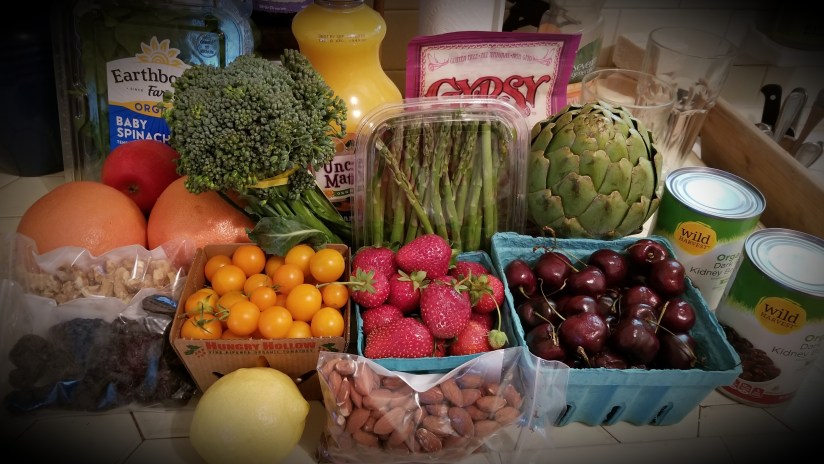
Photo by me:  foods rich in iron, folic acid and vitamins B-12 and C

It’s hard enough trying to balance all of the rules, changes, recommendations, and ups and downs of pregnancy, let alone to manage all of these things when you are over 35 years old.  There’s real pressure to make pristine choices to avoid and lower your risk – and because you’re older, your risk is greater – for everything from too much weight gain, too little weight gain, gestational diabetes, preeclampsia, anemia, low birth rate, and so on.

A huge part of my pregnancy journey has been my nutrition.  I have working knowledge of the best diet regimen for my personal bio-individual needs – especially since I have celiac disease and I need to boost my nutrient intake.  I have been taking a high quality, organic, food-based prenatal vitamin, along with a vitamin D3 supplement, prenatal DHA (Omega-3 support), and a 90-billion count probiotic.  All of these supplements address my personal needs.

Most importantly, I have been eating whole foods, organic whenever possible, and no processed food.  I have totally eliminated alcohol and significantly minimized my caffeine intake.  I’m following all of the rules.  I’m really trying!

At 17 weeks, I had my blood drawn for about 8 different vials – primarily for genetic testing and to learn our baby’s gender.  My inbox has been receiving messages daily with a new test result in, one by one.  All of the tests, thus far, have shown nothing but good health!  It’s been a relief.  However, yesterday, I received the results for my blood count with about 12 segments of my blood tested and analyzed.   My blood counts were all good, within normal ranges, except for my hemoglobin.  It was marked in the “Flag” section of the results with an ominous letter “L” for low.

My hemoglobin checked in at 11.5 g/dL, which is low for a non-pregnant healthy woman.  However, normal hemoglobin in pregnancy is typically anywhere between 10-14 g/dL.

So, what’s the deal with low hemoglobin and pregnancy?

Hemoglobin level of pregnancy can naturally lower to 10.5 gm/dL, which represents a normal anemia of pregnancy.  Normal anemia?

What is anemia?  It is a condition that develops when your blood lacks enough healthy red blood cells or hemoglobin. Hemoglobin is a main part of red blood cells and binds oxygen. If you have too few or abnormal red blood cells, or your hemoglobin is abnormal or low, the cells in your body will not get enough oxygen.

Anemia is very common!  Symptoms include fatigue, shortness of breath, dizziness or increased heartbeat.

Typcially treatment for anemia depends on the underlying diagnosis.  Iron supplements may be used for iron deficiency. Vitamin B supplements maybe used for low vitamin levels.  But, anemia in pregnancy is normal and can often be corrected via proper nutrition.

According to americanpregnancy.org, “a fall in hemoglobin levels during pregnancy is caused by a greater expansion of plasma volume compared with the increase in red cell volume.”  This is because pregnant women usually increase anywhere from 30 to 50 percent more blood volume than women who are not pregnant.

This is why pregnant women are often advised to increase their iron levels.  Ideally, this is accomplished by modifying the diet to eat more iron-rich foods.

I thought I was doing a good job of getting my daily recommended amounts of iron through my diet.  And, to be fair, I was probably doing a pretty good job.  This blood count test just affirmed for me the need to increase my food intake and by making healthy nutritious choices to meet those growing nutrient needs.

Your baby practically steals your nutrients from your body, so, your nutrient intake needs to exceed what is normal for you prior to pregnancy.

Many women will hear “low iron” and run for the burgers and steaks.  While lean meats are an excellent source for iron, it’s not enough.

While increasing your intake of iron-rich foods like whole eggs, spinach, artichokes, beans, lean meats, and seafood, you also need to add foods rich in cofactors – specifically folic acid, vitamin B12, and vitamin C – which are important for maintaining normal hemoglobin levels.   Keep in mind a cofactor is necessary substance that is essential for an enzymatic reaction to complete.  So, in order for your body to properly process iron, cofactors like folic acid, vitamin B12 and vitamin C are necessary for the enzymatic reaction to complete, breaking down the vitamins and minerals so that they can get absorbed into the blood stream to nourish you and your baby.

So, consuming all of the iron-rich foods in the world won’t matter if you don’t also eat cofactors to get the most out of the iron in your diet.  Make sense?

Here’s a list of iron-rich foods:
green leafy vegetables
spinach!
beetroot
tofu
asparagus
whole egg
apple
pomegranate
apricot
watermelon
prunes
pumpkin seeds
dates
almonds
raisins
artichokes
beans
lean meats
fish
poultry

Here’s a list of foods rich in cofactors folic acid, vitamin B12 and vitamin C:
fish
vegetables
nuts
cereals
peas
citrus fruits
strawberries
papaya
cherries
bell peppers
broccoli
tomatoes

For questions or concerns about low hemoglobin and anemia in pregnancy, contact your healthcare provider.  You can always start with managing your diet to include these nutrient-rich foods.  If your levels are still low, do not self diagnose iron or other supplements without your healthcare provider’s instruction.  This is because there are different doses and even possible contraindications associated with supplementation.  To protect yourself and your baby, it’s best advised to get professional advice based on your personal needs.
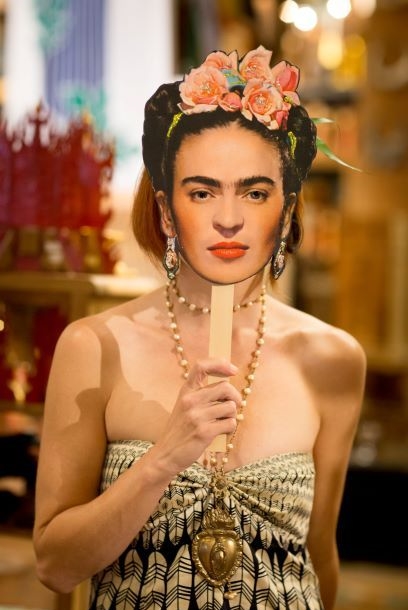


FRIDA KAHLO: cultural icon, social justice champion

valls_feastly_460
Photo courtesy of John Valls

There are many paintings by the Gran Artista that make me feel the depths of my own despair.  I can relate.  The painter who is by all standards a genius can make anyone feel an intended emotion, magically bridging worldviews and experiences to find common ground.

Even after undergraduate art history studies, a woman’s college education and many coffee house conversations on feminism in art, I could only imagine the suffering, pain, love, scorn, hopelessness, and defiance that Frida Kahlo spirited into her paintings. When I went to the cinema to see Julie Taymor’s critically acclaimed biopic, Frida, starring Salma Hayek, I began to understand.  By the time I was thirty-five, and had endured some pretty significant pain and loss, her work began to speak to me in a different voice. 

I have chosen to emulate Frida’s style for many of my professional events, from wearing brightly colored dresses to her signature flower crowns.  It wasn’t just to feel pretty, but to feel empowered.

I work in a male dominated business.  I often have to strike a balance between my masculine and feminine sides at work.  And, so did Frida.

Much of my life is centered around elaborate dinner parties.  Again, mostly through work.  I learned a bit about Frida’s elaborate dinner parties she used to call “dias de los manteles largos” or “days of the long tablecloths.”  She loved to entertain.  Frida, the film, presents examples of her comrades dining, dancing, singing and drinking.  Food was very important to Frida, and her grand-nieces published a cookbook based on Frida’s favorite recipes, most borrowed from the first wife of her husband, Diego Rivera.

I thought about recreating one of Frida’s dinner parties.  I thought about it some more.  In fact, I couldn’t stop thinking about it, so, I asked my friend, Julia Raymond, who oversees the Portland base camp for a multi-city culinary event promotion company, Feastly, to meet me for a cup of coffee.

Julia was on board immediately.  She invited me to a Feastly event showcasing a very special Mexican brunch.  There, she introduced me to Elizabeth Baena and Héctor Guerrero, chefs and owners of Chuparrosa Supper Club.

It was kismet.

This magical dinner would need a very special space.  We contacted Brigid, the owner of Cargo, Inc., a colorful, enchanting warehouse space filled with world goods.

Again, kismet.

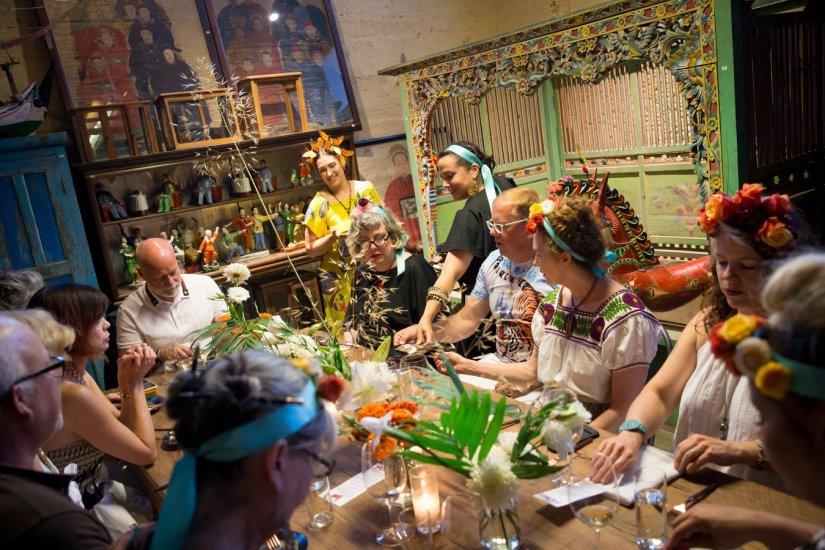
Weeks unfolded as we created an evening filled with the kinds of artistry that would appropriately conjure the spirit of Frida.  Creative spirits came forward wanting to be a part of this magical endeavor, all donating their products and services, including Nectar Graphics, John & Theresa Valls photography, Mezcales de Leyenda, Nicky USA, mariachi singer-songwriter, Edna Vazquez.


Photos courtesy of Cargo, Inc.

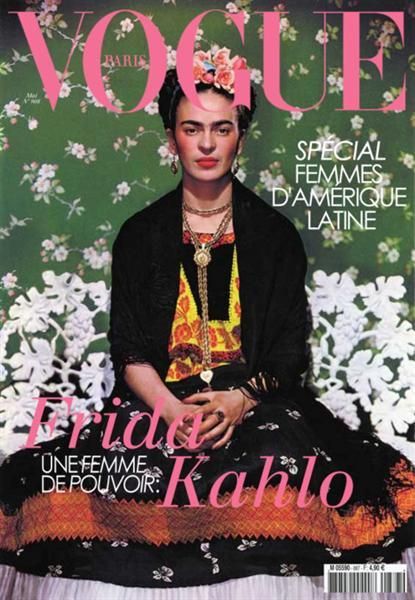
The evening unfolded with nothing short of magic!  Guests were welcomed at Cargo with real golden-orange flowers sprinkled on the rustic wooden floors, as if a religious ceremony was about to take place, a table of complimentary ribbon-tied floral crowns, and stunning Frida inspired art and merchandise installations, including a photo shoot drop with hand-painted flowers modeled after the 1939 French Vogue Magazine cover photograph of Frida.

Frida Vogue 1938

Photo from French Vogue, “Frida on Bench” by Nickolas Muray, 1939.

There were stations with tastes to delight our guests, including my wine table where I poured my 2017 Sauvignon Blanc and 2017 Rosé of Cabernet Franc; a lovely display of beautiful bites conjured up by Chuparrosa Supper Club; and a mini bar with luscious cocktails by Mezcales de Leyenda

All were enchanted by the powerful voice of Edna Vazquez.

Guests were escorted downstairs to a three course meal prepared by Chuparrosa Supper Club with wines paired by my business, Leah Jorgensen Cellars.

After the gorgeous meal, our very special guest, Leda Garside, was introduced to speak.  Leda is a veteran nurse with OHSU Tuality Healthcare and serves our community via ¡Salud!, an auction started by the Oregon Wine Industry to provide healthcare services and outreach to Oregon vineyard workers and their families.

Frida was a champion for social justice and many of her dinner parties were focused on politics and the people.  The heart of our Frida Kahlo birthday celebration was always centered on serving the local Mexican-American community, especially those underserved.  ¡Salud! was the obvious choice!  Leda spoke passionately about the important, noble work of this great cause.  A portion of the proceeds from ticket sales benefitted ¡Salud!

Frida dinnerPhoto courtesy of John Valls


Fertility & The Modern Woman


Fertility Challenge
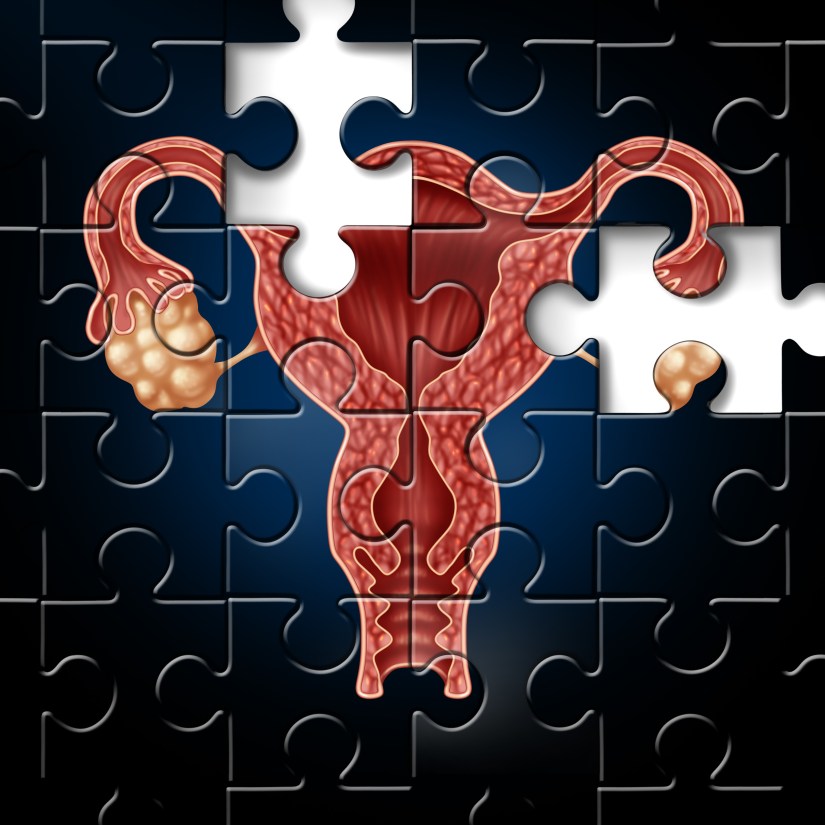
Fertility challenge and infertility medical symbol as an incomplete puzzle with an image of a uterus with fallopian tubes as a gynecology icon for problems in female reproduction in a 3D illustration style.

According to the US Department of Health and Human Services’ Office on Women’s Health, “infertility means not being able to get pregnant after one year of trying (or six months if a woman is 35 or older).  Women who can get pregnant but are unable to stay pregnant may also be infertile.  About 10 percent of women (6.1 million) in the United States ages 15-44 have difficulty getting pregnant or staying pregnant, according to the Centers for Disease Control and Prevention (CDC).” (womenshealth.gov).

When you are a woman trying to get pregnant, all the statistics in the world don’t matter.  You just want to be healthy.

As a woman who wanted to have a baby after the age of 35, which used to bear the unbearable name of “geriatric pregnancy”, I wasn’t sure about my fertility.  I wasn’t concerned with whether or not I would have children until I found the love of my life and began to see the world and a potential family through a new and different lens.

I decided to be proactive and googled fertility and acupuncture.  I wasn’t interested in taking the traditional path to western medicine.  I came across a clinic that was dedicated to women’s health.  There, I learned about Kiné Fischler and Willow Tree Wellness.

Kiné, the clinic director and distinguished Fellow of the American Board of Oriental Reproductive Medicine, is a master acupuncturist and medical herbalist specializing in women’s health, fertility and pregnancy care.  She has a Master of Science in Oriental Medicine from the Acupuncture & Integrative Medicine College in Berkeley, CA.  She is a proud member of the American Society for Reproductive Medicine, building professional relationships with Reproductive Endocrinologists to offer integrative care for mutual patients.

Her credentials are impressive.

I scheduled an appointment.  I immediately felt a good vibe about Kiné and was so happy to begin this journey.  She guided me through the process to understand my fertility.  She became a kind of yogi to me and she helped me to become my own advocate when it came to working with conventional medicine to address my needs and concerns.

First, I requested an appointment with my OB-GYN to learn about my chances of getting pregnant.  My doctor ran a series of tests to find out about my egg quality and if I’m nearing menopause.  The results came back promising.

Kiné had me track my cycle for the past year.  I have always had a short cycle – anywhere from 24-26 days.  She explained the importance of a longer cycle, closer to the normal 28 days.

Starting in October of 2017, we began a weekly treatment regimen of acupuncture and Chinese herbs to balance my hormones and lengthen my cycle.  Kiné explained it takes about six months of treatment to balance most clients towards healthy ovulation and pregnancy.

The process was amazing.  Kiné not only balanced my hormones and lengthened my cycle to 26-28 days, but her treatments alleviated my worst menstrual symptoms, including debilitating, painful cramps.  She also encouraged me to go back to my OB-GYN to test my levels of progesterone.

My doctor was very much on board with working as a team with my acupuncturist.  She ordered the progesterone test and even ordered an HSG test.  HSG, or hysteronsalpingography, is a special kind of x-ray used to evaluate female fertility and involves placing an iodine-based dye through the cervix and taking x-rays. The x-rays help evaluate the shape of the uterus and whether the fallopian tubes are blocked.

Interestingly enough, many women claim they got pregnant one or two months after an HSG.   Doctors suggest you’re more likely to conceive after this fertility test because it opens up the fallopian tubes and makes it easier for sperm to reach the egg.

I had the procedure done in early April of 2018.  The test results came back normal.

Meantime, my progesterone levels were low.  So, Kiné directed me to advocate for myself and ask my doctor to write me a progesterone suppository prescription.  This is very important.  My doctor was happy to write the prescription.  However, my health insurance company fought me and tried to change the prescription to a progesterone pill.  Here’s where it became critical for me to fight for my health and what I believed was best for my body.  My sister had a history of low progesterone and miscarriage.  The only thing that worked and gave her two babies was the use of progesterone suppositories.  The synthetic pill did not work for her and could not prevent miscarriage!

It was difficult to work with my insurance company.  But, I fought for what I knew was right for my body.  And, it took tears in the pharmacy to finally get some help.  While the pharmacist could not fill the prescription, he called a local compounder who could mix and fulfill the prescription – at a fraction of the cost!

The following month, on Mother’s Day, Sunday, May 13th, I took a home pregnancy test and was stunned by a positive sign.  I took the prescribed progesterone suppositories until the end of my first trimester.

I continue to see Kiné once a week for prenatal acupuncture and pregnancy support.  She is amazing!  I would not be pregnant if not for Kiné!

I decided to start my blog with this story because it is one of the most important stories of my life.  I didn’t know if I would ever get pregnant.  I feared my age would be prohibitive.  Our society scares women to death, especially when we are no longer young maidens.  We are placed to such incomprehensible standards about our choices, our lifestyle, our image, and our health.

Here’s my hope.  For any woman out there who is struggling to get pregnant, or who worries about her biological clock, or who feels invisible in the conventional healthcare system – please take heart.  I am over 40 years old and I did not need fertility treatment.  Please let that sink in.  I know that women have different issues and we are all bio-individuals, so you can’t make a blanket statement about a woman’s health at any stage.  Be your own advocate.  If you are healthy and take care of yourself, you are more than likely better off than you may realize.

Conventional medicine will not consider lengthening your cycle!  Acupuncture will and with results.  While you may have a normal 28 day cycle, you may have other disharmonies that a good acupuncturist will address.  These little imbalances may be all the difference in seeing results with conventional medicine.  It’s worth finding someone like Kiné to help you learn about your body.

I did not require fertility treatment to get pregnant.  It happened for me within 6 months of Kiné’s care.  My journey was to learn about my bio-individuality, my own needs and requirements.  I’ve had a short cycle since the beginning of my womanhood.  Acupuncture put my system on track.  I took tests to learn about my body.  I believe in manifesting.  And the very process of taking a holistic look at my health and fertility opened up the possibility of getting pregnant.  It worked.

Stress commonly prevents couples from conceiving.  I never had any stress because I was getting acupuncture – which helps to alleviate and/or prevent stress.  I approached my fertility clearly and objectively – but not always without emotion.  Fertility is an emotional topic!  But, I had a real team of healthcare providers who guided me through a beautiful process of discovery about myself.

I am in my early 40’s and I am fertile, healthy and happily pregnant.

The journey obviously doesn’t stop there.  I am integrating holistic nutrition to feed myself and my growing baby.  I am living on a budget, and, still I put my nutrition as my top priority.  I don’t eat processed foods at all, I’ve limited sugar, and I’m enjoying fresh, whole, organic foods whenever possible.

Kiné introduced me to Carol Gray of MamaSpace Yoga in Portland.  “MamaSpace is all about making room for babies in pregnant bodies.  When babies have room to move they assume more ideal positions for birth.  This unique prenatal yoga style enhances and supports the bodywork developed for pregnant people by Carol Gray.  The concept of maternal mobility making space for babies receives little attention in our culture, but is vitally important to fetal development and birth outcomes.”

Each decision I have made has empowered me, cleared me, and helped me manifest my health, pregnancy, and delivery goals.  Balancing my hormones via acupuncture came at a fraction of the cost of facing fertility treatment.

There are so many myths about women’s health.  Pregnancy and birth are incredible miracles.  I believe in every day miracles.  I believe you hold the power to realize a healthy pregnancy at any stage or age of fertility.   Of course, specific diseases require  different considerations and approaches.  Still, I will always enlist in acupuncture to support conventional care and I will always recommend this for everyone.