FIVE Postpartum Things I Learned From My Personal Trainer

woman chats with her personal trainer online

My postpartum journey has been going on for four years now. I struggled in my new body to rediscover what kind of exercise and movement was best for me. Prior to my pregnancy I had been an avid runner and gym-goer. But those former workouts were no longer working out for me.

I walked outside a bit and kept most of the weight off from nursing. But once the weening process began, with another round of hormonal havoc, along with low activity during the pandemic, I had packed on some pounds. Worse, I didn’t feel strong in my body. I felt broken. My postpartum injuries and pain were fully felt.

In the summer of my child’s second year I was visiting family and my cousin asked me if I wanted to join her for a thirty-minute workout with her personal trainer. It was a rewarding workout on her wrap-around porch and it made an impression on me. I wanted the convenience, ease, expertise and personal attention of a personal trainer, too!

I had looked for months, to no avail. I specifically wanted to find a female personal trainer out in wine country who would come to my house. Eventually I was able to manifest what I put out for the universe to work into place for me. I was on LinkedIn looking up something business related when I found Katie. I was looking for a personal assistant, at the time, but, for some reason (a-hem – the universe working its magic!) a personal trainer also came up in my search. Curious, I messaged Katie and she got right back to me. I quickly learned that while she lived in Oregon, too, we would workout virtually – which was even better for me! Further, I could actually afford the transaction.

Three and a half years after giving birth I started my first session with Katie. And it has been a life changing, mutually beneficial relationship. We have become friends and allies. Katie continues to help me on this journey of reclaiming my body, my strength, my balance, my endurance and my confidence. Along the way, she made some profound observations regarding my postpartum health and wellness, specifically with my hip pain, diastasis recti, and pelvic floor weakness – things completely ignored by my postpartum and family medicine healthcare providers. She helped me to finally recover and thrive.

Here are five amazing things I learned from my personal trainer that helped me to finally enjoy a full recovery from postpartum injury and trauma.


BRACE YOURSELF!
Brace your core, that is. My trainer advised that I not only brace my core when engaged in our workouts, but, to use this practice through out my day – walking up and down the stairs, doing laundry, washing the dishes, making dinner, in the shower, in the care, in line at the grocery store – anytime. For those new to this concept, bracing your core is mostly associated with the practice of contracting the muscles around the spine to created a tight midsection often engaged when bending your knees to lift something heavy. This prevents back injury. But bracing your core is also a great engagement during your workouts to build the abdominal muscles while in yoga positions or other functional training. This creates stability around your spine. After growing a baby, your core gets moved around and your abdominal muscles relax. Part of the recovery from childbirth is your organs and muscles eventually fall back into place. But this doesn’t always happen perfectly. Strengthening the core should be a part of every postpartum woman’s eventual workout regimen (when cleared by healthcare provider). Bracing the core supplements all core training and really supports all of the spots a postpartum woman needs to focus on – including pelvic floor and diaphragm.


RE-LEARN HOW TO BREATHE!
When you are in your third term of pregnancy your breathing changes. Your baby is taking up more real estate, your diaphragm and lungs are not in the same space for deep, whole core breathing. Your body naturally adapts – and the crazy part? You don’t even realize your breathing has changed to compensate for your baby’s growth. The way you breathe starts higher up, and you often lift your shoulders up to pull in a “deep” inhale. Your exhale is short. Women tend to carry on breathing this way long after baby has been born. One day, I mentioned to my personal trainer that I often felt discomfort whenever I had to do forward bends. Not pain. Just a weird feeling as I folded over the top of my belly under my breasts. It was my postpartum bump that never fully went away. She paused for a moment and told me she believed it had to do with how I was breathing. She said it was my diaphragm that was causing the discomfort. And then I learned about diaphragmatic breathing. This became a deeply emotional recovery because I carried on breathing the wrong way for over four years. I was breathing wrong during horrible head colds and even when I was sick from Covid-19. I often felt like I was suffocating whenever I was congested and sick. Diaphragmatic breathing was so foreign to my body that I had to totally re-learn how to breathe in expanding my tummy like a balloon, a movement that engages your entire core and pelvic muscles. The exhale is long, slow and works its way all the way back up your core. It’s an exercise in itself! I wrote about the importance of diaphragmatic breathing and how it’s the most important practice for postpartum healing – which you can read all about here.


TUNE INTO THE MOON!
You don’t have to follow astrology or understand it completely to receive the benefits of what the universe is energetically delivering for us. I happen to have a personal trainer who is deeply engaged in astrology and I am very interested in metaphysics and certainly the greater impacts around us that can work for us – and sometimes against us. But, my trainer taught me that customizing our workouts to the rhythms of the universe – especially lunar cycles – can really have an impact on outcome. Full moon? New moon? She can create a bespoke workout to address my needs. She knows my birth chart and considers sweeping cosmic changes that are going on for me when she considers what type of workout would be best. I may need more of a restful workout with deep stretching. Or, I may need to get my heart rate going and double down on strength training. I can feel a difference when my workouts are in synch with greater energies of the cosmos versus when I would throw down a workout that poorly coincided with astrological activity – symptoms of feeling drained, over-tired, challenged with recovery, or not feeling like I got enough from my workout – all of these things have happened when I wasn’t working out with metaphysical rhythms. It’s amazing and not so surprising, if you think about it. There is a certain grace that can be experienced when one is in tune with the shifting energies around us. I also consider my water intake during and following workouts in response to the lunar cycle. We know how deep the water/moon connection is – and what this means for flushing out our kidneys, etc. Traditional Chinese Medicine holds an ancient, deep philosophical and medical understanding of the connection of astrology and physical well being that fully supports this practice.

LESS IS MORE!
Many women fall victim to the assumption and pressure that they must rid themselves of the baby bump and baby weight as soon as possible. There’s shame around the changed body of a new mother and baby weight is often regarded as fat. This is horrible on so many levels. Healing is often disregarded in exchange for body dysmorphia. Postpartum hormones can dangerously play into the negative self talk. Body acceptance is so critically important. And beyond that acceptance, a newfound appreciation, awe, and gratitude for creating and growing another human being are necessary for self love. I’m so relieved that I never cared about the aftermath of my postpartum body. I mean, I was deep in the process of needing to heal. There was no time or energy to worry about how I looked. Instead of trying to implement the over the top workouts that were part of my pre-pregnancy routine – running, working out at the gym and regular yoga classes – I let go of the virtues of hard core. I look at movement differently – how I get it, where and when I get it. Instead of hitting the pavement or treadmill hard, opt for long walks outside or nature hikes to get in some forest bathing. I make it a priority to engage in movement that I enjoy. Part of my movement routine includes two thirty-minute workout sessions a week with my personal trainer and we mostly cover functional strength training aiming to heal and strengthen my core, pelvic floor and hips. We get a lot in during those sessions, with exercises that typically are two-for-one, meaning they engage core and get my heart rate going or they stretch my hips while adding a little strength training for my arms, and so on. I’m getting the most holistic workouts and I’m not putting in the same frenetic energy as I once did, and I’m still getting great results!


HIPS DON’T LIE!
Hips are getting a lot of attention in the fitness and physical therapy world. It’s not just pregnant and postpartum mamas needing extra care there. There’s all kinds of information out there about the somatic relationship of pain, trauma and our emotions being stored in our hips. Which means our hips are also a great wellspring for offering deep, emotional healing. In my case, I experienced birth trauma and a hip injury during labor. In addition to the normal pressure pregnancy puts on our hips, I was carrying the weight of a lot more trauma and emotional stress that got stored into my hips. The good news is yoga instructors and certain personal trainers can gently address the hip pain and somatic tension, pressure and blockage. My personal trainer has been a champion in the area of healing for me. We have worked on various stretches that have put me in poses that immediately released pain – not just physically but emotionally. I would often get tears in my eyes for no reason while holding certain positions that opened up my hip joints. Whether engaged in dead bug, airplanes, hula hoop circles – my trainer has an endless list of moves that strengthen, stretch and relieve the hips. It’s been incredibly therapeutic. Plus, when I brace my core and practice diaphragmatic breathing while holding these hip positions it’s like the heavens have opened up and filled me up with the most intense, beautifully healing and strengthening light and energy offering deep healing through and through.

The important thing to point out here is that I would not have come to many of these conclusions on my own. I didn’t know what I needed – even though I’m a former athlete and coach. Postpartum recovery isn’t always intuitive and in most cases we don’t know what we don’t know! I highly recommend finding a personal trainer or yoga class that expertly works with postpartum women to recover, heal and find new strength in a new and glorious body.
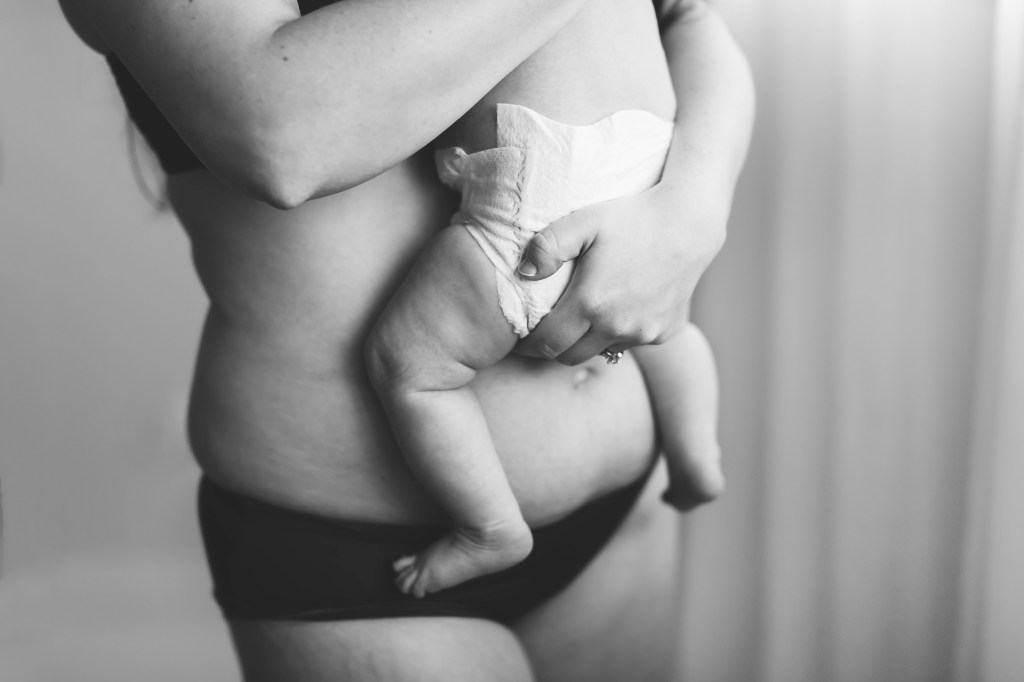
Why I Could Not “Fix” My Body After Pregnancy… Until Four Years Later

I have written quite a bit about my pregnancy and postpartum experiences.

I was very slow to get in any real movement following the whole child birthing experience. Even a couple of years after giving birth, I was still nowhere near having the body I had before my pregnancy. I didn’t get how some women would even try to “bounce back” with vigorous workouts and unfaltering determination to lose that “baby belly”. Weren’t they still healing, too?

I was an older mom giving birth for the first time. I didn’t care about how long the baby bump would linger. I just wanted to feel strong again, and recovered. Having a c-section certainly changed any post game workout plans I had. I walked a little. And that was pretty much it. For me, movement included chores around the house. But, I wasn’t up for yoga or the likes of Peloton. I gave myself a long break.

Nursing prevented me from gaining any extra weight. But, still, I felt… broken.

For me, childbirth left me with painful, sticky hips, no feeling in my pelvic region, and diastasis recti – abdominal separation leaving a gaping space where my abs should have reconnected. It has been nearly impossible to recovery my core.

Fast forward to the present – four years postpartum. I now have a personal trainer and for more than six months we’ve been working on recovering my core, pelvic floor, and toning up, in general. While I do feel stronger, I can’t really see any difference in the tone or shape of my body. My hips still hurt on the regular.

One day, a few weeks ago, I had bent over abruptly and felt discomfort in the space that would have been the top of my baby bump, under my breasts, at center – my core. Basically, I described the discomfort to my personal trainer from folding over on top of that space that held my former baby bump. It wasn’t painful, just a jarring discomfort that took my breath away. After a long pause, she said she believed it had to do with my diaphragm. And diastasis recti. But, really she was concerned with my diaphragm and how I was breathing.

I wasn’t sure what my diaphragm had to do with it. But, she said it would benefit me to continue working on bracing my core throughout the day. She said we would dig deeper the following week.

I took it upon my self to research the diaphragm and the postpartum body. What I learned brought me to tears. Not happy ones. But, tears of frustration. So much of my postpartum pain and suffering and discomfort could have been avoided had a healthcare practitioner told me that I needed to work on diaphragmatic breathing immediately following childbirth.

What I didn’t know cost me time and energy and extended pain and discomfort.

When I left the hospital after giving birth, I was forgotten. Lots of trips to the pediatrician to check in on my son. But, me? Nah, the hospital could care less. Other entities provided information online about the importance of diaphragmatic breathing – but, not the hospitals, not the healthcare providers. Do they not know this? Why would they withhold this key practice and rehab? You have to find your postpartum recovery and rehab wellness from yoga instructors and other professionals who seem to care more about the postpartum woman than doctors, nurses and hospitals.

So, what is diaphragmatic breathing and why is it so important to a postpartum woman?

When a woman is in her third trimester, after her organs have shifted around to make room for her growing baby, there is a great deal of pressure on the diaphragm and lungs, and the mother’s breathing eventually shifts from deep breaths lowering and expanding the diaphragm like a balloon to shallow breaths getting pushed upward, as if the shoulders are lifting the breath from the lungs. It happens without noticing it. The interesting thing is that many women continue to breathe like this long after the baby is born – like years after the baby is born.

This shallow, shorter breath starting from the chest, lifting the shoulders, gives you less oxygen and doesn’t work the core, so it keeps the weakened spots weak. This is a problem for many reasons, but, from a postpartum recovery standpoint, not breathing from the diaphragm will not help to recover a weakened core and pelvic floor, which then creates all kinds of compensations – including weak glutes, tight hips and sore back.

So, I struggled, even with a personal trainer, to see a significant change in my core, pelvic floor, glutes and hips. And, getting your breath to work properly again will restore the muscular balance to your body. This breathing will also prevent and heal postpartum issues like diastasis recti, incontinence and pelvic organ prolapse.

There is lots of great information about diaphragmatic breathing online. I found great therapeutic help here:

brb Yoga: core strength for life – How To “Fix” Your Body After Pregnancy

Browse the brb Yoga site for all kinds of postpartum healing resources.

I also learned more about diaphragmatic breathing here:

Mother.ly – “The answer to postpartum recovery may be how you breathe…”

The big take away for me is that it’s never too late to recover your breathing. I started doing diaphragmatic breathing exercises and techniques so that after a weekend of practice, my breathing was improved. I still have to work at it to get my natural breathing fully back, but, I am no longer doing the weird, short breaths that had started in my third trimester.

When I think about living through horrible colds and Covid-19 over the past couple of years – it’s no wonder I had suffered so badly! I wasn’t breathing right to begin with!

Had I not brought up the weird sensation in my belly to my personal trainer, I would have never arrived at this therapeutic postpartum rehab – that is the most essential technique that all women should do immediately after birth. Who knows if I would have ever returned to normal breathing. This is serious rehab that gets completely missed from hospitals and minimal OB-GYN postpartum care. How is it that postpartum women are not given this important instruction following birth?

As Brooke Cates, author of the Motherly article states, “correct breathing lays the foundation for healing and restrengthening your inner core. With breath, you begin the healing process postpartum by simultaneously rehabbing both the deep core and the pelvic floor.”

Cates explains once you’re breathing from your diaphragm again, you will have a calm, natural breathing sensation versus a stressed and more forced breathing action. I felt this shift 100%!

So, fast forward to exercise and movement to regain strength in your core, pelvic floor, and so on – “once your breath is re-wired you can progress with deep core-based activations, functional movements and smart core-based exercises.”

While I lamented that I could have felt so much more support, empowerment and strength just weeks postpartum, I allowed myself to mourn that absence of rehab for the past four years and move on. I finally have hope regarding these key issues of not feeling supported, empowered or strong. I had written in my journal for the past two years that I felt physically powerless and weak. And no more. One weekend of diaphragmatic breathing has already made a difference. I am excited to reap more benefits of this incredible rehab and finally reclaim my health and my body after four years of struggle.

It’s never too late to correct your breath. It’s never too late to heal your postpartum body. And I just want to share this with every woman I know who has had a baby or is about to have a baby. No one should suffer from the lack of support, empowerment and strength that is a given with the right postpartum rehab. If hospitals won’t share this with new mothers, then I suppose it’s up to mothers to pass this along.

An Exploration of Self Healing

wa-aromatouch.jpg
Image courtesy of doTERRA (doterra.com)


One of the worst conditions following childbirth was a case of a painfully numb thigh.  I endured a long (traumatic) labor beginning with early labor for two days at home with manageable contractions, followed by 24 hours of “active” labor at the hospital that led to 3 hours of pushing until my baby stopped descending and would not pass through the pelvic bone – you could see my baby’s head – which made me believe I would successfully push him for a normal vaginal delivery.  Unfortunately, after several grueling positions of pushing, baby was not budging.  The doctor and nursing staff prepared me for a C-section surgery.

Somewhere within the 24 hours of active labor and pushing I asked for an epidural.  And, of course, that line was used to anesthetize me from my tummy down for surgery. I was given morphine and other pain killers that ended up with alternating rounds of Ibuprofen and Tylenol.

I had been retaining a bit of water in my ankles and feet during my last trimester – normal edema.  In the hospital, with the introduction of intervention medicine to induce labor, my legs swelled up a bit more.  When I returned home after surgery, my legs were painfully swollen with fluids from pregnancy, hormones, and childbirth.  They felt tight and somewhat numb.  Over the course of a few days, the swelling went down, the water retention went away, and my left leg felt totally normal.  My right thigh, however, held on to the numbness for days.

The numbness became one of the worst experiences of my healing and recovery story.  It prevented me from getting much needed sleep to heal.  It felt like tinnitis or some other annoying tick that just wouldn’t go away.  I started researching online numbness in the thigh following childbirth – with different experiences associated with epidural, c-section, or childbirth, in general.  I then polled my Facebook friends to see if other mothers had experienced either temporary or permanent numbness from an epidural or C-section.  I had so many responses that it made me feel less paranoid about my own numbness.  Most said they had experienced temporary numbness in a leg and most said it lasted anywhere from several weeks to a couple years!

At this point, I wasn’t concerned with what caused the numbing aches.  I just wanted relief.  I had tried to be patient with my recovery – they say it takes a minimum of six weeks to recover from a C-section.  But, I was recovering from what was more like two birth experiences – my son making it through the birth canal and then a C-section.  I was a swollen, sore mess.

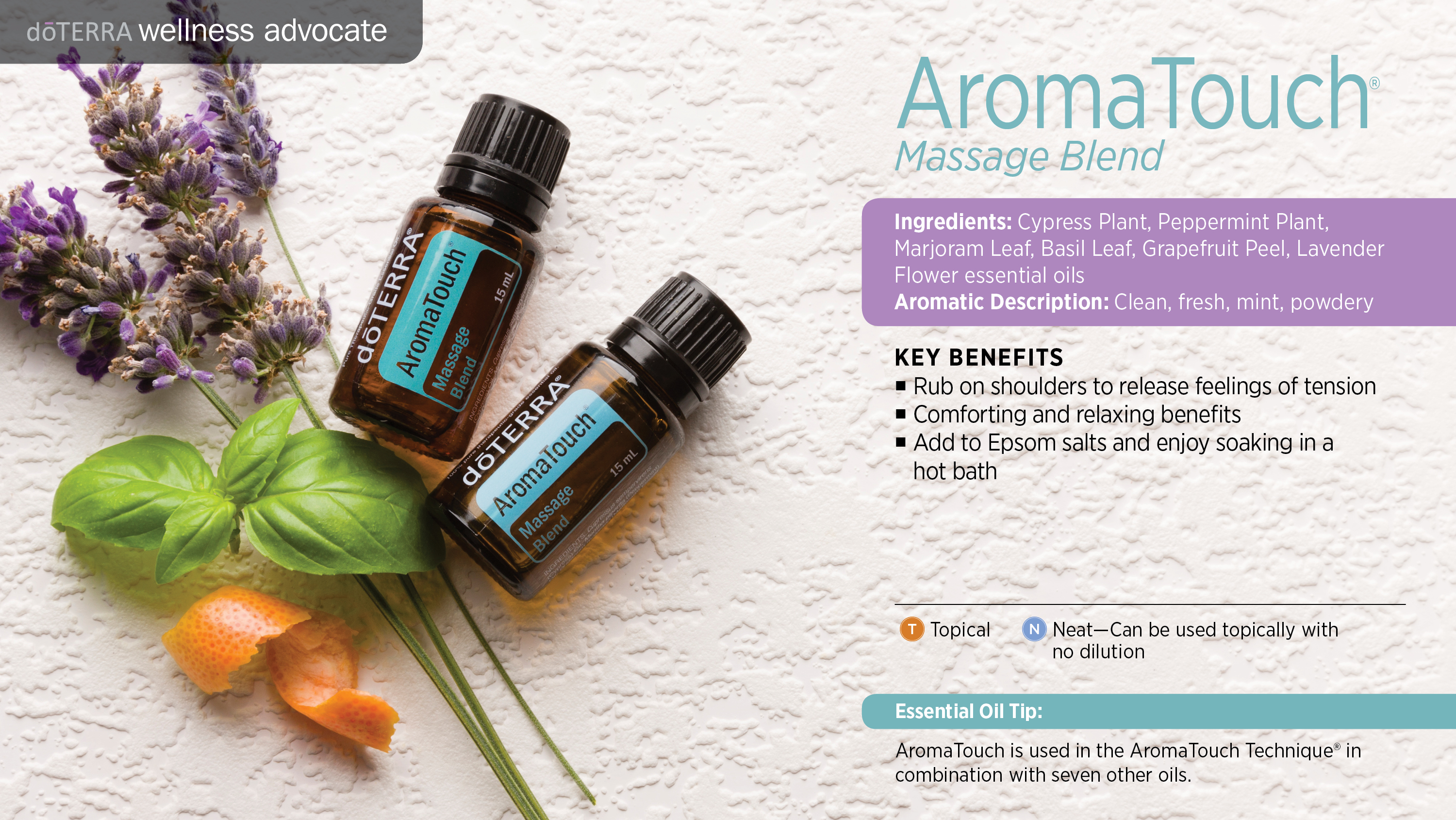
After a week, much of my swelling was subsiding.  I was beginning to feel a little bit better.  The numb leg was making me crazy.  Finally, I tried ice packs at night to see if it would help.  It did not.  I agonized over the thought of having this linger for months or even over a year.  I tried a heating pad.  It did nothing.  Finally, after two and a half weeks had passed since giving birth, I pulled open my bag of doTERRA essential oils.  I had one in particular that I though might be soothing – a proprietary blend called “Aromatouch”.

Now, there are clear warnings to consult your doctor before using essential oils with pregnancy or breastfeeding.  So, I am not advocating that every mother start slathering up the doTERRA oils for relief.  You need to know what you’re using, what risks are involved, if any, and what contraindications are involved, if any.

I used a small amount to massage into my numb thigh – a couple drops by my knee, a couple more near my hip.  I rubbed out my numb thigh for about ten to fifteen minutes.  I slept that night.

In the morning, my leg felt better.  The numbness was still there, but it was dull.  I don’t know if it was the massage, the oil blend, or the combination that eased the numbing pain.  All I know was that it felt better.  I walked around my house more to stretch out my thigh, get some circulation.  I had been drinking copious amounts of water to assist in breastfeeding, and was eating thoroughly nourishing and nutritious snacks and meals to make my former nutrition school instructors proud.  I was taking high quality, food based, organic prenatal vitamins, fish oil for omegas, vitamin D and a probiotic to supplement my diet.  I was making the best choices I possibly could for healing and nourishing myself and my baby.

The next evening, I added one more application of the doTERRA “Aromatouch” massage oil with a vigorous ten to fifteen minute thigh massage.  Again, I slept that night.

It’s been a couple of days and the numbness is barely there.  Certain sitting positions seem to aggravate the tissue, but then I’ll get up and walk it out.  It is still there, but it is very dull and at times unnoticeable.

The image above lists the ingredients in the doTERRA “Aromatouch” blend.  I wasn’t sure if any of these oils specifically addressed nerve injury.  So, I looked up nerve damage (neuropathy) and essential oils.  The following essential oils have been long associated with addressing nerve pain: Roman chamomile, peppermint and lavender.  Both peppermint and lavender are in the “Aromatouch” blend.

Peppermint essential oil is attributed to relaxing muscles, controlling muscle spasms and acting as a pain reliever.  Lavender is attributed to improving sleep and acting as a pain reliever, but, recent studies suggest lavender plant extract produces an anticonvulsant and anti-spasm effect.

I’m not one to sware by essential oils.  I believe they have their place in healing and wellness.  But, I also believe individuals need to work with their regular healthcare providers – doctors, naturopaths, acupuncturists – to ensure safe use and dosage.


Winter Has Come

49418262_2351443598228701_252584776114896896_n

I took a hiatus from this blog.  Once I got into the thick of Harvest 2018, while in the second trimester of my first pregnancy, I lost the ability to think outside of the demands of bringing in grapes, processing grapes, fermenting grapes, pressing grapes and putting nascent wine into barrel for winter hibernation.

Winter is my season.  I was born in the midst of an ice storm in Havre de Grace, Maryland in the month of January, after all.  I love snow and staying home to stay warm.  But, this year, as harvest wrapped up and the holidays came along, I felt a sense of melancholy.  This was the first time I had missed spending Christmas with my family – ever.  It’s bad enough that I don’t get to see my family enough.  Missing our family traditions made me feel alienated in our quiet, little farm abode in Newberg, Oregon.  I missed my family.  I missed the Christmas traditions that I looked forward to sharing with my family:  driving through the neighborhood to look at the Christmas lights; the Italian tradition of the feast of the seven fishes on Christmas Eve; Midnight Mass; Danish smørrebrød on Christmas morning; watching my young niece and nephew enjoy the magic and wonder of Christmas morning; enjoying the cozy togetherness, the simple art of hygge (the Danish art of coziness); and going out for the annual holiday movie with my siblings (specifically the blockbuster sequel genres of Harry Potter, The Lord of the Rings and Star Wars).

I had to miss going home for the holidays because I was 36 weeks pregnant and unable travel across country by airplane.  And while many friends in my social media circles tried to console me and remind me that I have my own home now and my own family – a doting husband and a baby on the way – I couldn’t shake my winter blues.

While there’s nothing like going home for Christmas, it turns out that my many friends in my social media circles were right.  Traditions can be edited, families grow, and life goes on.  My sweet husband worked hard to ensure my winter – and the holidays – were still warm and cozy.  They were different, but no less special.  We had Christmas Eve dinner with his father, aunt and cousins; we attended Midnight Mass at the beautiful Grotto in Portland; he made us a beautiful Danish smørrebrød on Christmas morning; we quietly opened up gifts that were all for our soon-to-arrive baby; and, on New Year’s Eve we had a magical dinner in and set off crackers that sent brightly colored streamers to adorn our Christmas tree while sipping on Champagne, and then we slow danced to Auld Lang Syne.  It was all perfect.

I got my wonderful winter.  My birthday came along and my husband made a perfect Coq au Vin which we paired with a special bottle of 2011 Clos Roche Blanche Cuvée Pif.  This wine is significant for several reasons.  For one, I made my first wine for my business in the same vintage – 2011.  Clos Roche Blanche was the inspiration for the first red wine I ever made – my Oregon “Tour Rain” Vin Rouge – which is 40% Gamay Noir and 60% Cabernet Franc.  The 2011 CRB was born to go with my husband’s Coq au Vin.  It was nice to finally sip on some wine without repulsion during this pregnancy.  It was like falling in love with wine all over again!

As these annual markers and milestones passed, we were closer to delivering our baby.  On the weekend of our 38th week gestation we decided to take a last minute “babymoon”.  I got the green light from my doctor and we packed up for a much needed respite up on Mt. Hood.  We arrived at our friend’s quaint cabin in the snowy village of Government Camp.  We enjoyed precious time together – just the two of us before becoming three – cooking lovely meals, my husband building the best woodstove fires, playing rounds of gin rummy, snuggling, taking easy walks in the snow, and then snowshoeing a moderate trail for two miles on our last day on the mountain.  I was proud of myself for snowshoeing at 38 weeks pregnant!  It felt wonderful – my joints opened up, the fresh air was like medicine, and the snowfall was a welcome peace.  Our babymoon was winter jubilation.

The following week, I began early labor at home.  Winter had come.

After two days of early labor at home, we checked into the hospital for a light induction.  More than 24 hours later, after active labor followed by 3 hours of pushing, and a baby not passing through the pelvic bone, we were carted into surgery for a C-section.  Our beautiful baby boy was born on January 15th.

For a winemaker, this is the perfect time to have a baby.  The barrels were getting topped, as needed.  And plans for bottling the white wines in March have already been made with minimal work to do beforehand.  My husband was able to take off four weeks from work so that we could create our little fourth trimester cocoon.  We have been cozy at home, our Christmas tree still up (and quite a hit for our newborn’s gazing delight), sleeping, napping, breastfeeding, and eating nourishing, comforting winter foods – rich yellow lentil soup, beef chili, lasagna, baked sweet potatoes, southwest hash browns with farm eggs – our refrigerator and freezer prepped before heading to the hospital.  And, many of our friends in the wine business helped us out with a meal train – bringing restaurant quality foods and groceries to our front door.

We aren’t leaving the house and we aren’t opening up the door for visitors.  We are using this time to nurture and protect our newborn, allowing me to heal from both pushing in active labor and a c-section, and using this time for family bonding.  We are also in the midst of a measles outbreak in the greater Portland / Southwest Washington area – which is causing a bit of panic for many of us with babies under a year old who cannot get vaccinated.  It’s crazy, but suddenly it feels more like 1819 than 2019 with mostly anti vaxxers’ children under the age of 10 getting sick, but, putting babies and immune compromised people in danger.

Sign of the times, I guess.  The world seems crazy!  It is why I take even more comfort in staying home with my husband and baby for a winter hibernation.  It is quiet, healthy and perfect.  I am activated to write more in the few precious moments when I can sit down while the baby is sleeping, sip on some hot tea, and give my patient, sweet cat some attention.  I have a lot on my mind right now – mostly about parenting and processing a traumatic birth and dealing with the physical discomforts that come with healing from childbirth.  So, the blog will reflect what’s going on in my mind.  Eventually, it will turn back to winemaking thoughts and nutrition and living on our sweet farmstead in Oregon wine country.  There’s plenty of time for those things.  We are very much in the moment now, and that reflects mid winter, some solitude and the earliest days of caring for a newborn – with all of its beauty and wonder.  Yes, I got my wonderful winter.