

My postpartum journey has been going on for four years now. I struggled in my new body to rediscover what kind of exercise and movement was best for me. Prior to my pregnancy I had been an avid runner and gym-goer. But those former workouts were no longer working out for me.
I walked outside a bit and kept most of the weight off from nursing. But once the weening process began, with another round of hormonal havoc, along with low activity during the pandemic, I had packed on some pounds. Worse, I didn’t feel strong in my body. I felt broken. My postpartum injuries and pain were fully felt.
In the summer of my child’s second year I was visiting family and my cousin asked me if I wanted to join her for a thirty-minute workout with her personal trainer. It was a rewarding workout on her wrap-around porch and it made an impression on me. I wanted the convenience, ease, expertise and personal attention of a personal trainer, too!
I had looked for months, to no avail. I specifically wanted to find a female personal trainer out in wine country who would come to my house. Eventually I was able to manifest what I put out for the universe to work into place for me. I was on LinkedIn looking up something business related when I found Katie. I was looking for a personal assistant, at the time, but, for some reason (a-hem – the universe working its magic!) a personal trainer also came up in my search. Curious, I messaged Katie and she got right back to me. I quickly learned that while she lived in Oregon, too, we would workout virtually – which was even better for me! Further, I could actually afford the transaction.
Three and a half years after giving birth I started my first session with Katie. And it has been a life changing, mutually beneficial relationship. We have become friends and allies. Katie continues to help me on this journey of reclaiming my body, my strength, my balance, my endurance and my confidence. Along the way, she made some profound observations regarding my postpartum health and wellness, specifically with my hip pain, diastasis recti, and pelvic floor weakness – things completely ignored by my postpartum and family medicine healthcare providers. She helped me to finally recover and thrive.
Here are five amazing things I learned from my personal trainer that helped me to finally enjoy a full recovery from postpartum injury and trauma.

BRACE YOURSELF!
Brace your core, that is. My trainer advised that I not only brace my core when engaged in our workouts, but, to use this practice through out my day – walking up and down the stairs, doing laundry, washing the dishes, making dinner, in the shower, in the care, in line at the grocery store – anytime. For those new to this concept, bracing your core is mostly associated with the practice of contracting the muscles around the spine to created a tight midsection often engaged when bending your knees to lift something heavy. This prevents back injury. But bracing your core is also a great engagement during your workouts to build the abdominal muscles while in yoga positions or other functional training. This creates stability around your spine. After growing a baby, your core gets moved around and your abdominal muscles relax. Part of the recovery from childbirth is your organs and muscles eventually fall back into place. But this doesn’t always happen perfectly. Strengthening the core should be a part of every postpartum woman’s eventual workout regimen (when cleared by healthcare provider). Bracing the core supplements all core training and really supports all of the spots a postpartum woman needs to focus on – including pelvic floor and diaphragm.
RE-LEARN HOW TO BREATHE!
When you are in your third term of pregnancy your breathing changes. Your baby is taking up more real estate, your diaphragm and lungs are not in the same space for deep, whole core breathing. Your body naturally adapts – and the crazy part? You don’t even realize your breathing has changed to compensate for your baby’s growth. The way you breathe starts higher up, and you often lift your shoulders up to pull in a “deep” inhale. Your exhale is short. Women tend to carry on breathing this way long after baby has been born. One day, I mentioned to my personal trainer that I often felt discomfort whenever I had to do forward bends. Not pain. Just a weird feeling as I folded over the top of my belly under my breasts. It was my postpartum bump that never fully went away. She paused for a moment and told me she believed it had to do with how I was breathing. She said it was my diaphragm that was causing the discomfort. And then I learned about diaphragmatic breathing. This became a deeply emotional recovery because I carried on breathing the wrong way for over four years. I was breathing wrong during horrible head colds and even when I was sick from Covid-19. I often felt like I was suffocating whenever I was congested and sick. Diaphragmatic breathing was so foreign to my body that I had to totally re-learn how to breathe in expanding my tummy like a balloon, a movement that engages your entire core and pelvic muscles. The exhale is long, slow and works its way all the way back up your core. It’s an exercise in itself! I wrote about the importance of diaphragmatic breathing and how it’s the most important practice for postpartum healing – which you can read all about here.
TUNE INTO THE MOON!
You don’t have to follow astrology or understand it completely to receive the benefits of what the universe is energetically delivering for us. I happen to have a personal trainer who is deeply engaged in astrology and I am very interested in metaphysics and certainly the greater impacts around us that can work for us – and sometimes against us. But, my trainer taught me that customizing our workouts to the rhythms of the universe – especially lunar cycles – can really have an impact on outcome. Full moon? New moon? She can create a bespoke workout to address my needs. She knows my birth chart and considers sweeping cosmic changes that are going on for me when she considers what type of workout would be best. I may need more of a restful workout with deep stretching. Or, I may need to get my heart rate going and double down on strength training. I can feel a difference when my workouts are in synch with greater energies of the cosmos versus when I would throw down a workout that poorly coincided with astrological activity – symptoms of feeling drained, over-tired, challenged with recovery, or not feeling like I got enough from my workout – all of these things have happened when I wasn’t working out with metaphysical rhythms. It’s amazing and not so surprising, if you think about it. There is a certain grace that can be experienced when one is in tune with the shifting energies around us. I also consider my water intake during and following workouts in response to the lunar cycle. We know how deep the water/moon connection is – and what this means for flushing out our kidneys, etc. Traditional Chinese Medicine holds an ancient, deep philosophical and medical understanding of the connection of astrology and physical well being that fully supports this practice.
LESS IS MORE!
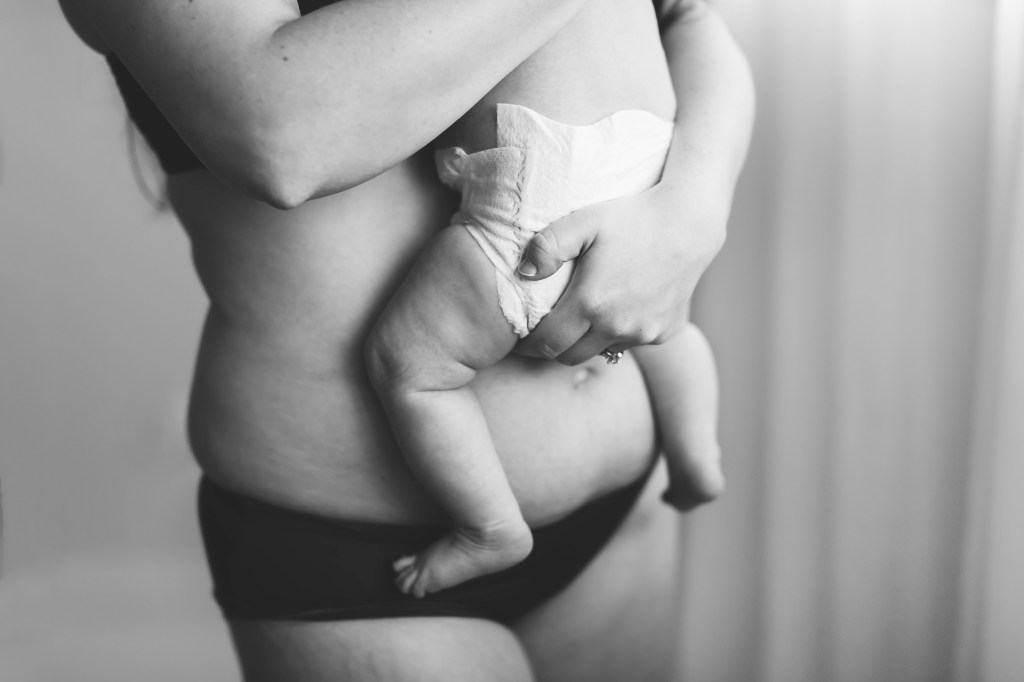
Many women fall victim to the assumption and pressure that they must rid themselves of the baby bump and baby weight as soon as possible. There’s shame around the changed body of a new mother and baby weight is often regarded as fat. This is horrible on so many levels. Healing is often disregarded in exchange for body dysmorphia. Postpartum hormones can dangerously play into the negative self talk. Body acceptance is so critically important. And beyond that acceptance, a newfound appreciation, awe, and gratitude for creating and growing another human being are necessary for self love. I’m so relieved that I never cared about the aftermath of my postpartum body. I mean, I was deep in the process of needing to heal. There was no time or energy to worry about how I looked. Instead of trying to implement the over the top workouts that were part of my pre-pregnancy routine – running, working out at the gym and regular yoga classes – I let go of the virtues of hard core. I look at movement differently – how I get it, where and when I get it. Instead of hitting the pavement or treadmill hard, opt for long walks outside or nature hikes to get in some forest bathing. I make it a priority to engage in movement that I enjoy. Part of my movement routine includes two thirty-minute workout sessions a week with my personal trainer and we mostly cover functional strength training aiming to heal and strengthen my core, pelvic floor and hips. We get a lot in during those sessions, with exercises that typically are two-for-one, meaning they engage core and get my heart rate going or they stretch my hips while adding a little strength training for my arms, and so on. I’m getting the most holistic workouts and I’m not putting in the same frenetic energy as I once did, and I’m still getting great results!

HIPS DON’T LIE!
Hips are getting a lot of attention in the fitness and physical therapy world. It’s not just pregnant and postpartum mamas needing extra care there. There’s all kinds of information out there about the somatic relationship of pain, trauma and our emotions being stored in our hips. Which means our hips are also a great wellspring for offering deep, emotional healing. In my case, I experienced birth trauma and a hip injury during labor. In addition to the normal pressure pregnancy puts on our hips, I was carrying the weight of a lot more trauma and emotional stress that got stored into my hips. The good news is yoga instructors and certain personal trainers can gently address the hip pain and somatic tension, pressure and blockage. My personal trainer has been a champion in the area of healing for me. We have worked on various stretches that have put me in poses that immediately released pain – not just physically but emotionally. I would often get tears in my eyes for no reason while holding certain positions that opened up my hip joints. Whether engaged in dead bug, airplanes, hula hoop circles – my trainer has an endless list of moves that strengthen, stretch and relieve the hips. It’s been incredibly therapeutic. Plus, when I brace my core and practice diaphragmatic breathing while holding these hip positions it’s like the heavens have opened up and filled me up with the most intense, beautifully healing and strengthening light and energy offering deep healing through and through.
The important thing to point out here is that I would not have come to many of these conclusions on my own. I didn’t know what I needed – even though I’m a former athlete and coach. Postpartum recovery isn’t always intuitive and in most cases we don’t know what we don’t know! I highly recommend finding a personal trainer or yoga class that expertly works with postpartum women to recover, heal and find new strength in a new and glorious body.
 COSMIC BITS